

Purpose
The purpose of this safety alert is to report on a vehicle hoist failure and to provide guidance on the installation and maintenance of post-installed anchors, used to anchor vehicle hoists onto concrete slabs. Post-installed anchor is the term used to describe any type of anchor inserted into a hole that is drilled into hardened concrete, and includes torque-controlled anchors, drop-in anchors, concrete screw and chemical type anchors.
Background
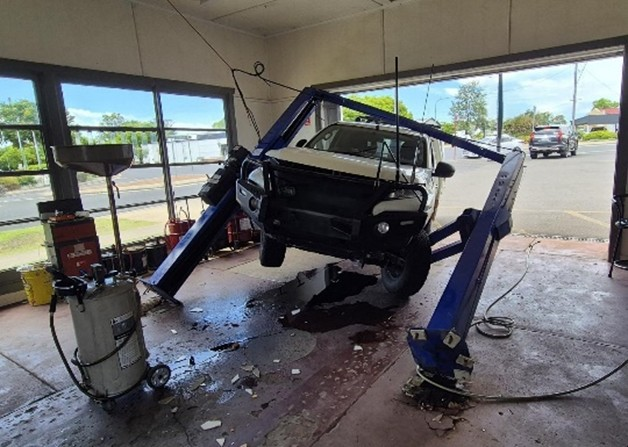
In 2025, a vehicle hoist fell over, dropping a 2.5-tonne vehicle (refer Figure 1).
The unit was a two-post vehicle hoist with a four-tonne maximum rated capacity. No workers were injured, but the incident had the potential to result in serious or fatal injuries.
The incident occurred due to the failure of the anchorage system used to attach the two posts to the concrete slab. The base plates on each of the two posts were attached to a concrete slab, using five mechanical torque-controlled expansion anchors. All the anchors were torn away from the concrete slab with a variety of failure modes. Some were pulled straight out of their holes, others caused cone failure in the concrete, and others tensile failure of the bolt shank.
Contributing factors
The cause of the incident is likely to be complex due to a range of possible contributing factors. The failure of post-installed anchors on a vehicle hoist could be caused by a number of factors including the following:
- Inadequate design of anchors including overloading of anchors (e.g. using fewer anchors or anchors that are too small). Some other examples of design issues include: use of anchors in concrete of low strength, inadequate thickness, no or inadequate reinforcement.
- Failure to install the anchor in accordance with the manufacturer’s installation instructions, for example, incorrect hole diameter and depth, inadequate hole cleaning, tightening torque, hitting steel reinforcement, etc.
- In the case of two-post hoists, a pull-out load may be applied to anchors due to the difficulty in getting the vehicle’s centre of gravity aligned with the posts. In addition, where the hoist design does not include bracing between the top of the two posts, there would be significant side loading due to the way the arms support the vehicle. This force would tend to pull the top of the posts together. This would mean that the post base plate would tend to pull the anchors, on the outside of each post, upwards and out of the concrete floor.
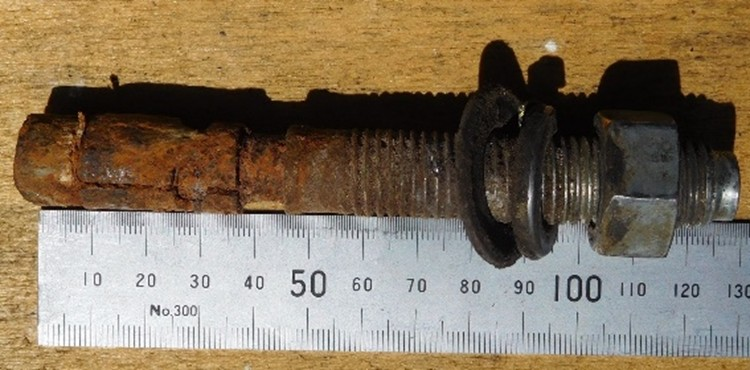
- Metal corrosion of the anchor over time, for example where a floor was washed with water and water remains in holes. Unfortunately, corrosion of critical parts of the anchor is hidden while the top of the anchor may be undamaged (refer Figure 2). Refer to the document AEFAC TN15 – Durability of Fasteners for additional guidance.
- Cyclic loading applied to the anchors when loading and unloading the hoist and as the vehicle is worked on.
- Mounting the hoist posts on uneven floor surfaces. Although packers are sometimes used to level hoists, the effectiveness of an anchor could be reduced on uneven surfaces with an increased risk of an anchor loosening over time.
- Use of the incorrect type1 of anchors for this application.
- Failure to carry out periodic inspection and maintenance of the anchors.
- Action required
Building, hoist and anchorage selection
Where a building is constructed specifically as a vehicle maintenance facility, it may be possible for cast-in ferrules or threaded rod to be installed in the building slab during construction, before concrete is poured. These cast-in anchorage options will generally have better long-term performance, if designed and installed correctly, in comparison to the use of post-installed anchors. Cast-in anchorage systems should also provide a much easier option when installing hoists, provided the components have been cast in the correct locations.
Before selecting and installing a vehicle hoist in an existing building, it is important to check that the design and construction of the concrete slab is compatible with the vehicle hoist specifications, and the anchorage system to be used. The concrete needs to be of a minimum strength, thickness and condition so that the specific type of post-installed anchor, specified by the hoist manufacturer, can be installed in accordance with the manufacturer’s installation instructions.
Where the floor is of questionable quality the advice of an expert in post-installed anchors should be obtained, for example by the anchor manufacturer or a suitably qualified professional engineer. It may be necessary to pour new concrete footings for the vehicle hoist where the installation location has compromised concrete. Where the floor is uneven or out of level, advice should also be sought from a competent person as to whether packers can be used, or the floor should be modified to make it level. The use of non-shrink grout under the post plates is one alternative provided the grout is not so thick that it compromises the strength of the anchor.
Two-post hoists are by far the most common type of vehicle hoist in use. There has been an increase in the capacity of two-post hoists over many years which has allowed for use with heavier vehicles. Prior to this, heavier vehicles were lifted using four-post hoists. Both two and four-post hoists typically have the base plate on each post attached to the floor using post-installed anchors.
The loading on anchors for a four-post hoist will be less severe than a two-post hoist because there is minimal pull-out force applied to anchors. Pull-out forces can be significant on a two-post hoist.
Owners and operators of vehicle service facilities should consider installing at least some four-post vehicle hoists, especially where heavily loaded or larger vehicles are regularly serviced. A heavily loaded vehicle may make it difficult to ensure the vehicle is correctly located on the hoist to maintain the necessary load balance as specified by the vehicle hoist manufacturer.
The centre of gravity of a loaded utility vehicle may be well towards the rear of the vehicle rather than near the vehicle’s centre line.
Anchor selection
The vehicle hoist design will determine the installation requirements, and the manufacturer’s information must specify the requirements for securing the hoist. Designers, manufacturers, importers and suppliers must provide information related to the assembly or use of plant at a workplace. Recommended information to be included with any vehicle hoist is included in AS 1418.9:2024 Cranes, hoists and winches Part 9: vehicle hoists.
The Australian Standard includes guidance on the installation and commissioning information supplied with any hoist. This includes instructions addressing the supporting surface (for example, concrete strength and thickness), installation instructions (including detailed instructions for any post installed anchor) and the testing and acceptance criteria after commissioning. Refer to AS 1418.9 for further details. The information provided with any hoist should meet the guidance in this alert in addition to the requirements of AS 1418.9.
The use of post installed anchors for anchoring of vehicle hoists is a safety critical application. Therefore, the anchor should have been tested and assessed as suitable for such an application by the anchor manufacturer (for example, anchor pre-qualification). The anchorage system should be designed in accordance with Australian Standard AS 5216-2021 Design of post-installed and cast-in fastenings in concrete. Anchors should be installedby a suitably competent and qualified installer such as trained by Australian Engineered Fasteners and Anchors Council (AEFAC) or the anchor manufacturer’s representative.
Deformation type anchors, thin sleeve torque-controlled anchors, drop-in anchors and screw bolts are not recommended due to their limited ability to resist long term cyclic loading. Screw bolts rely on a thread being cut into the concrete, and this thread could be damaged especially if periodically retightened with an impact driver.
All mechanical anchors should be installed with a calibrated torque wrench to the anchor manufacturer’s installation torque unless the manufacturer specifies alternative methods of installation. Where anchors are supplied by the hoist manufacturer, specific information on the anchor is to be included with the instructions. The information should include all the installation instructions that would be supplied by the anchor manufacturer, and should include the following information, at a minimum:
- Minimum concrete strength and slab thickness.
- The condition, strength and reinforcement requirements of the concrete for the anchor used. Refer to AS 5216 for further advice.
- Minimum distance to the edge of the concrete.
- Minimum spacing between anchors.
- Hole diameter, depth and hole preparation.
- Installation method including the tightening torque.
- Whether the anchor can be re-tightened if it becomes loose over time and/or the frequency of re-tightening and its re-tightening torque value.
- If packers are permitted, the maximum packer thickness and anchor capacity (designed in accordance with AS 5216).
Chemical anchors rely on an effective bond between the anchor rod (for example, a threaded rod) and concrete being maintained for the life of the structure. Where used it is important that all of the manufacturer’s installation instructions are followed including the correct type of chemical adhesive, correct amount of adhesive and the adhesive being within its use by date.
If anchors are used in a location where water may be present (for example, cleaning floors with water, outdoor installations) the use of anchors resistant to corrosion2 should be considered.
Maintenance
Inspection of the anchorage system, by a competent person, should form part of the routine scheduled maintenance for the vehicle hoist that is specified in the manufacturer’s user manual. Inspection of the anchorage system should include, but not be limited to, the following:
- Checking the anchor nuts or bolts3 are not loose and the post base plates are secure – initially when the hoist is not lifting a vehicle and then with a vehicle being lifted by the hoist if the initial inspection shows nothing unusual.
- Checking whether the anchors have moved from the originally installed position.
- Checking for visible signs of water in the anchor holes where applicable. Where water has been present for some time, the anchor may have been weakened (refer Figure 2).
- Checking for cracking in the floor slab – especially cracking around the post-installed anchors. Where cracks intersect with anchor holes this is a strong indicator that the integrity of the anchorage system has been compromised.
- Inspecting around packers where used, to verify the packers are not loose or cannot be easily moved.
Where the inspection shows the anchorage system may have been compromised, the advice of a suitably qualified person, such as a professional engineer with relevant experience should be obtained.
Where the damage could reduce the safety of the hoist, the vehicle hoist should be tagged out of service and electric power to the hoist isolated, to prevent the hoist being used.
A signed damage report should be prepared by the competent person carrying out the inspection.
This report may recommend remedial action to make the hoist safe. In some situations, the only alternative may be to replace the existing concrete footing and anchorage system.one.
Source: WorkSafe Qld


